Breakfast
Featured

banana date bread
Even though we've only lived here four years, Brian and I have fallen completely in love with Charlottesville. One of the things we enjoy most about this little city is the strong local food movement. We visit the farmer's market each weekend during the season to gather our meat, eggs and produce for the week (whatever we're not growing in our own garden) and have long conversations with our favorite farmers. We get to see photographs of the chickens who lay our eggs pecking the ground in their grassy field, the cows and their new calfs, and the bee hives housing the bees that are pollinating the plants from which our vegetables grow.
 It is undoubtably our favorite part of the week, and we make sure to leave ourselves with plenty of time to talk to Richard about the problems we are having with our own tomato plants and to gush to Jean about the magic of her hens’ eggs. We have a direct connection to the people who supply the food on our table, something that I think the majority of the world population doesn’t have and may not understand.
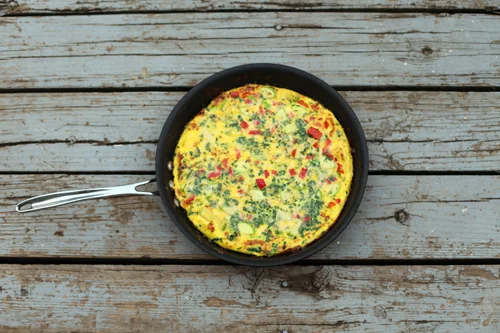
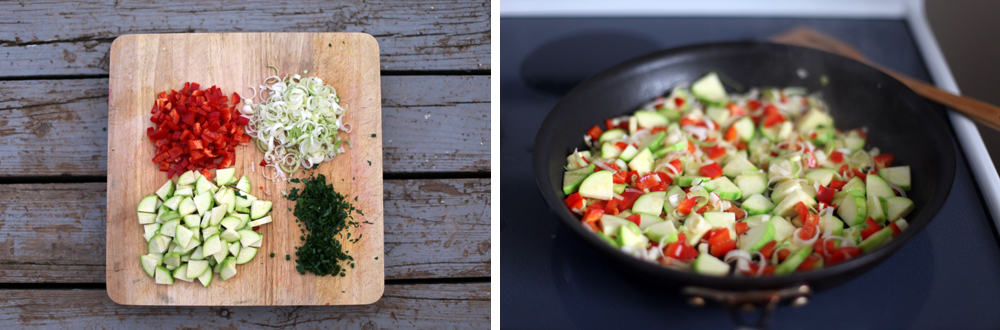
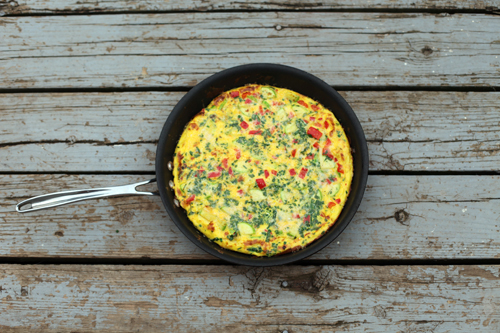 I know that we're very fortunate, and was reminded of it again last week when I made this vegetable frittata. As we sat down to eat I realized that every single ingredient, except for the parmesan cheese and olive oil, was locally grown. The eggs, milk, bell pepper, leeks and zucchini all came from the farmers' market, and the herbs were grown in our own garden. How cool is that?!? I'm not trying to rub it in, I'm really not, I just had to share with you all the amazing feeling that I had knowing that our dinner was not only delicious, but also supporting our local farmers.
 With Food, Inc. just out (which I haven't seen yet, gasp!) I've read a lot more chatter in the food blog world about being aware of where our food comes from. Its exciting, and I'm so glad to see bloggers with serious readership and influence supporting the cause. To join in, I wanted to share a couple of sites I've recently read about that may help you discover local food providers in your area. And, for my Charlottesville readers, I've added a new local page to the top bar. I know that I am probably missing a lot of great resources so if you have any to add, please leave a comment!
 I challenge you all to make this frittata and try to include at least one local ingredient, even if it is just herbs from pots on your porch. Every little bit counts!
Feel free to switch up the veggies, the recipe is very versatile. And delicious too, I might add.
Farmers' Market Frittata
Ingredients:
I challenge you all to make this frittata and try to include at least one local ingredient, even if it is just herbs from pots on your porch. Every little bit counts!
Feel free to switch up the veggies, the recipe is very versatile. And delicious too, I might add.
Farmers' Market Frittata
Ingredients:

It is undoubtably our favorite part of the week, and we make sure to leave ourselves with plenty of time to talk to Richard about the problems we are having with our own tomato plants and to gush to Jean about the magic of her hens’ eggs. We have a direct connection to the people who supply the food on our table, something that I think the majority of the world population doesn’t have and may not understand.
I know that we're very fortunate, and was reminded of it again last week when I made this vegetable frittata. As we sat down to eat I realized that every single ingredient, except for the parmesan cheese and olive oil, was locally grown. The eggs, milk, bell pepper, leeks and zucchini all came from the farmers' market, and the herbs were grown in our own garden. How cool is that?!? I'm not trying to rub it in, I'm really not, I just had to share with you all the amazing feeling that I had knowing that our dinner was not only delicious, but also supporting our local farmers.
With Food, Inc. just out (which I haven't seen yet, gasp!) I've read a lot more chatter in the food blog world about being aware of where our food comes from. Its exciting, and I'm so glad to see bloggers with serious readership and influence supporting the cause. To join in, I wanted to share a couple of sites I've recently read about that may help you discover local food providers in your area. And, for my Charlottesville readers, I've added a new local page to the top bar. I know that I am probably missing a lot of great resources so if you have any to add, please leave a comment!
I challenge you all to make this frittata and try to include at least one local ingredient, even if it is just herbs from pots on your porch. Every little bit counts!
Feel free to switch up the veggies, the recipe is very versatile. And delicious too, I might add.
Farmers' Market Frittata
Ingredients:
- 8 large eggs
- 1/2 cup plain greek yogurt (for a silkier texture) or 1/2 cup whole milk
- 4-5 good grinds of sea salt
- pinch of freshly ground black pepper
- 2 tbsp fresh chives, minced
- 1/4 cup fresh parsley, minced
- 1 red bell pepper, chopped to 1/4-inch dice
- 1 zucchini, chopped to 1/4-inch dice
- 1 leek, white and pale green part only, halved then sliced thinly
- 2 tbsp olive oil
- 1/2 cup freshly grated parmesan cheese
- Whisk together eggs, salt, pepper and yogurt or milk until smooth. Add minced herbs and stir well, set aside.
- Heat oil in 10 or 12 inch nonstick skillet over medium heat. Add bell pepper, zucchini and leek. Cook for 8-10 minutes, until veggies are tender.
- Increase heat to medium-high. Pour egg mixture over veggies evenly. Cook on medium high for 3-4 minutes, tilting pan and lifting edges of frittata to allow raw egg to run underneath.
- Lower heat to low, cover pan and cook for an additional 8-10 minutes, until frittata is mostly set. Shake pan occasionally while cooking. Meanwhile, place a rack at the top of the oven and turn broiler on to high.
- Remove frittata from stovetop when it is mostly set. Sprinkle cheese across top and place in oven, under broiler. Broil for 1-2 minutes, watching carefully to not let it get to brown. You just want a few spots of brown across the top, and bubbly cheese.
- Remove from the oven and allow to cool in pan for about 5 minutes. Remove to cutting board or large plate, cut into wedges and serve.
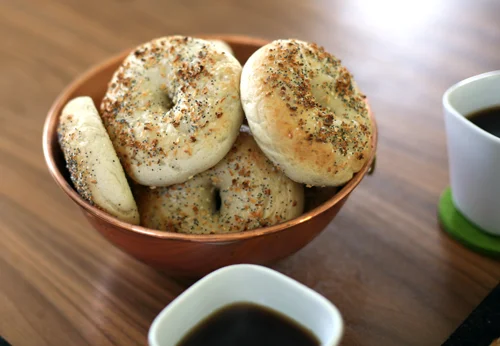
A long time ago I owned a bread machine. With that machine I made my husband (then boyfriend) batches of everything bagels on a bi-weekly basis. It was so easy to dump all of the ingredients in, leave the machine unattended for 3-1/2 hours, then boil and bake the bagel dough until golden brown. Well, three years ago we bought a house. A very small house with a kitchen that lacks any kind of storage space, especially space for a clunky bread machine. So, three years ago Brian stopped getting homemade bagels for breakfast and instead made do with bagels from the local shop, sliced then frozen then thawed when desired. And, for three years he's been asking me to start making homemade bagels again.
 I agreed to get rid of the bread machine not only because we had zero space for it, but also because I thought it would be a way to force myself to learn how to bake yeast breads from scratch. It seemed like a great idea since I already loved to bake cookies and muffins and quick breads - Brian even bought me a beautiful book to help in my endeavors. Unfortunately, the arrival of that book in our house coincided with my first semester of graduate school, which means that nary a loaf nor bagel was baked as I studied the affect of wind on structures and built teeny, tiny models of buildings at all hours of the night. Although I've been out of school for a full year now, I've just recently begun tackling yeast breads. And two weeks ago, much to Brian's delight, I tackled bagels.
 It really wasn't a difficult task, making bagels from scratch, especially with Peter Reinhart's The Bread Baker's Apprentice as my tutor. Yes it was handy to have the bread machine take care of all of the mixing and kneading and resting and kneading again, without my having to keep an eye on a clock. However, with a little forethought and a a stand mixer (I'm sure you could make these with a handheld mixer and a lot of elbow grease, but I'm not that brave) the bagels can be started Saturday evening and baked up just in time for Sunday morning breakfast. And they are delicious - so much better than the bread machine bagels of our past. The overnight fermentation process adds a great flavor that you just can't match in 3-1/2 hours.
 Now, I'm not from New York or Philadelphia or any other city whose residents claim that they have the *best* bagel. I didn't grow up eating bagels every week so don't have the kind of nostalgia associated with them that so many other people have. I don't claim to have had the best bagel of my life when I was growing up in such-and-such city, and certainly haven't spent my life trying to find one that compares. So, while I can't personally claim that this bagel will match the bagel of your past, I do trust Peter Reinhart when he claims that this is a bagel for the ages.
 This recipe produces a bagel with a chewy exterior, soft interior and endless possibilities for toppings. I froze ours in gallon-size bags once they had cooled, and simply microwaved them for 30 seconds before slicing and toasting when we were ready to eat them. The flavor and texture were still perfect.
Before typing out the [rather lengthy] recipe, I did a quick search to see if I could find a link online. Luckily, Smitten Kitchen came through. For Peter Reinhart's bagel recipe, from The Bread Baker's Apprentice, click here.
This recipe produces a bagel with a chewy exterior, soft interior and endless possibilities for toppings. I froze ours in gallon-size bags once they had cooled, and simply microwaved them for 30 seconds before slicing and toasting when we were ready to eat them. The flavor and texture were still perfect.
Before typing out the [rather lengthy] recipe, I did a quick search to see if I could find a link online. Luckily, Smitten Kitchen came through. For Peter Reinhart's bagel recipe, from The Bread Baker's Apprentice, click here.

I agreed to get rid of the bread machine not only because we had zero space for it, but also because I thought it would be a way to force myself to learn how to bake yeast breads from scratch. It seemed like a great idea since I already loved to bake cookies and muffins and quick breads - Brian even bought me a beautiful book to help in my endeavors. Unfortunately, the arrival of that book in our house coincided with my first semester of graduate school, which means that nary a loaf nor bagel was baked as I studied the affect of wind on structures and built teeny, tiny models of buildings at all hours of the night. Although I've been out of school for a full year now, I've just recently begun tackling yeast breads. And two weeks ago, much to Brian's delight, I tackled bagels.
It really wasn't a difficult task, making bagels from scratch, especially with Peter Reinhart's The Bread Baker's Apprentice as my tutor. Yes it was handy to have the bread machine take care of all of the mixing and kneading and resting and kneading again, without my having to keep an eye on a clock. However, with a little forethought and a a stand mixer (I'm sure you could make these with a handheld mixer and a lot of elbow grease, but I'm not that brave) the bagels can be started Saturday evening and baked up just in time for Sunday morning breakfast. And they are delicious - so much better than the bread machine bagels of our past. The overnight fermentation process adds a great flavor that you just can't match in 3-1/2 hours.
Now, I'm not from New York or Philadelphia or any other city whose residents claim that they have the *best* bagel. I didn't grow up eating bagels every week so don't have the kind of nostalgia associated with them that so many other people have. I don't claim to have had the best bagel of my life when I was growing up in such-and-such city, and certainly haven't spent my life trying to find one that compares. So, while I can't personally claim that this bagel will match the bagel of your past, I do trust Peter Reinhart when he claims that this is a bagel for the ages.
This recipe produces a bagel with a chewy exterior, soft interior and endless possibilities for toppings. I froze ours in gallon-size bags once they had cooled, and simply microwaved them for 30 seconds before slicing and toasting when we were ready to eat them. The flavor and texture were still perfect.
Before typing out the [rather lengthy] recipe, I did a quick search to see if I could find a link online. Luckily, Smitten Kitchen came through. For Peter Reinhart's bagel recipe, from The Bread Baker's Apprentice, click here.