why, hello!

I’m Andrea. I like to cook and bake and take photographs and write about life. Welcome to Bella Eats, where I share these passions of mine with you. I’m glad you’re here.

follow along
looking for...
my other projects

Friday
Oct282011

caramel apples

Caramel apples. The perfect Fall treat, bringing to mind images of carnivals and festivals and Halloween parties. I've made a few variations of candied apples in the past but this version is by far my favorite. This caramel is heavy and dark, laced with mollasses and dark corn syrup for an earthy undertone and not-overly-sweet flavor. If you're not a fan of molasses I'd avoid this recipe as, while not overpowering, the molasses does play a significant supporting role in the dance across the tastebuds. I loved this subtle difference from regular carnival candied apples that can sometimes make your teeth ache with sweetness.  That's not to say that this particular caramel isn't sweet, because it is, it is just balanced nicely by that molasses addition.

I'm not feeling too wordy today, friends, but felt the need to get this recipe out to you while there are still some orange and yellow leaves clinging to the trees.  Especially to all of you northeasterners who are facing the first nor'easter of the year.  What the heck?!?  I assume there will be some time spent indoors this weekend, lamenting the loss of Autumn so early.  Why not spend that time making the perfect Fall treat?

Hello, Winter? Could you back off please?

Happy weekend, friends!

Caramel Apples

from simply recipes

makes 12

note that you will need an accurate candy thermometer for this recipe

Ingredients

  • (1) 1-pound box dark brown sugar
  • 1 cup (2 sticks) unsalted butter, room temperature
  • (1) 14-oz can sweetened condensed milk
  • 2/3 cup dark corn syrup
  • 1/3 cup pure maple syrup
  • 1/2 tsp vanilla extract
  • 1 tsp dark mollasses
  • 1/4 tsp salt
  • 12 sturdy lollipop sticks, chopsticks, or twigs (these aren't great for holding, better for apples you plan to cut into slices)
  • 12 medium apples

Method

  1. Combine sugar, butter, condensed milk, corn syrup, maple syrup, vanilla, molasses and salt in a thick-bottomed 2-1/2 or 3-quart saucepan. Stir with a wooden spoon on medium-low heat until all of the sugar dissolves. You can test this by rubbing a little bit of the caramel between your fingers (let it cool on a spoon a bit first!!!). There should be no grittiness.  Brush down the sides of the pan with a wet pastry brush to dissolve any sugar crystals that might form on the pan sides.
  2. Attach a clip-on candy thermometer to the pan and cook the caramel at a rolling boil until the thermometer reaches 236℉, stirring constantly and slowly with a wooden spatula.  Be sure to scrape the bottom of the pan as you stir, so that the caramel doesn't stick.  Once it sticks it will burn, and you'll have to start over.  Continue to occasionally brush the sides of the pan down with a pastry brush.  Carefully pour the caramel into a metal bowl and allow it to cool until the temperature lowers to 200℉, at which point you are ready to dip the apples.
  3. While the caramel is cooling, prepare a large baking sheet, covering it with parchment paper, butter aluminum foil, or a silpat. Insert your sticks into each apple core (I used a chopstick to poke the holes for the twigs).
  4. When the caramel has cooled enough for dipping, dip the apples in, one by one, by holding on to the stick, and vertically lowering the apple into the caramel, submerging all but the very top of the apple. Pull the apple up from the caramel and let the excess caramel drip off from the bottom back into the pan, then place the apple on the prepared baking sheet. The caramel will pool a little at the bottom of each apple. Place the sheet in the refrigerator to chill for at least 15 minutes.  At this point, if you'd like to add toppings, do so.  Otherwise, allow the apples to chill for at least one hour.
  5. I recommend, after chilling, storing the apples at room temperature.  Otherwise the caramel is hard as a rock.

Friday
Oct142011

torta di mele | apple tart

My goodness...I should not have underestimated the powers of a beautiful salad! Thank you all for your sweet comments and enthusiasm. I won't lie, I fully expected to receive a whopping 2 comments on yesterday's post, so I appreciate all 10 of you proving me wrong. :)

As promised, here is an apple tart to kick off your weekend. It is your reward for yesterday's salad love, friends. This here tart is one of those pesky editorial assignments that I was telling you about, the completely fun and delicious and right-up-my-ally projects that cause me to eat more sweets/sushi/potato chips/wedding cake than maybe I should. This particular recipe was made and photographed for C-Ville Weekly and published in last week's issue. I'm just a little behind in getting it up here on Bella Eats. But, for all of you Charlottesville folks, Relay Foods has all of the ingredients ready to add to your cart in one click should you choose to make this apple tart this Fall. And you really should, as it is simple and lovely and delicious...three qualities I strive for in most food coming out of my kitchen.

Your tart will most likely look just a little bit different than mine because, well, I messed with the recipe a little bit. And wrongly, I might add. Your apples probably won't sit so high on the base, and the base itself won't be quite as dense. Even though I added a tad too much flour we still loved this treat.  I can't wait to make it again, sticking to the recipe below.

The pattern cut into the apples is, other than pretty, very helpful to slicing the tart in any way you might wish.

Torta di Mele (Apple Tart)

serves 8

from Meredith Barnes, C-Ville Weekly October 4-10, 2011

Ingredients

  • 1 egg
  • 3/4 cup sugar
  • pinch of salt
  • zest from 1 lemon
  • 1-1/2 sticks (3/4 cup) unsalted butter, melted
  • 2 cups all purpose flour
  • 1 tbsp active dry yeast
  • 1 tsp vanilla extract
  • 6 tbsp milk
  • 4 tart apples, peeled, cored, and halved
  • 2 tbsp apricot preserves
  • 2 tbsp water
Method:
  1. Preheat the oven to 375°.  Butter and flour a 9" or 10" cake pan, tapping to remove excess flour.
  2. Place the egg, sugar, salt, and lemon zest in the large bowl of a food processor.  Pulse until mixture is starting to combine and then add the melted butter, continuing to pulse until smooth.
  3. Combine the flour and yeast, and add to the mixture in the processor. Pulse until evenly distributed, add the milk and vanilla, and then process until a soft batter forms.  
  4. Pour the batter into the prepared pan and spread across the pan until it is level.
  5. Deeply score the 8 apple halves in a grid pattern.  Place one half in the center of the cake pan and arrange the remaining halves in a circular pattern. Bake for 10 minutes, the reduce the oven temperature to 350° and bake for 35-40 minutes more, until a toothpick inserted into the center comes out clean.
  6. Meanwhile, combine the 2 tbsp apricot preserves with the 2 tbsp water in a small saucepan and stir over low heat until melted.  When the tart comes out of the oven, brush it with the preserves and bake for an additional 3 minutes.  Serve warm.

Thursday
Oct132011

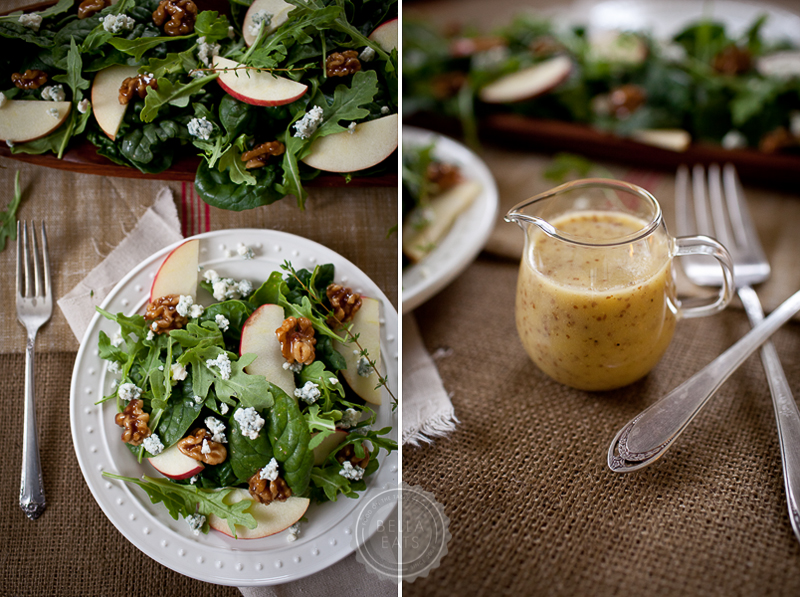
autumn salad with apples, blue cheese, + candied walnuts

And this, friends, would be an example of an AHubb meal. Or, an AHubb meal following a couple of weeks of BHubb meals, multiple food-centered editorial assignments, and a day-long photoshoot involving roughly 800oz of potato chips. Which, yes, we kept and distributed [mostly] to friends and family. With the fast approach of the holiday season and even heavier meals for impending Winter days, I've decided to challenge myself to create an interesting salad each week. To keep me on track, grounded, and hopefully in my current jeans. Not that I'll share each of them here. I know...you all really enjoy recipes more closely aligned with orecchiette carbonara and peach cakes. Who doesn't? But I thought, maybe, some of you might appreciate a few healthier options sprinkled here and there.

We all have those days when our jeans fit just a little tighter than the last, when we are craving something complex and hearty and cheesy for lunch but know we should choose the green salad instead. This recipe is my compromise. With a healthy dose of greens and apples, and a modest sprinkling of blue cheese and candied walnuts, it satisfies without the guilt. Make it lighter by omitting the candied walnuts and just sprinkling them on raw...but gosh, they sure are tasty.

Never fear...I'll be back tomorrow with a recipe for apple torte. :)

The combination of apples, blue cheese, and candied walnuts is well-loved and known for salads. Sometimes you just need a little reminder about an old favorite.

Autumn Salad with Apples, Blue Cheese, + Candied Walnuts

serves 4

Salad Ingredients

  • 4 cups fresh spinach
  • 2 cups fresh arugula
  • 1 tart apple, cut into 1/4-inch slices
  • 1/2 cup crumbled blue cheese

Candied Walnut Ingredients

  • 1/3 cup (packed) brown sugar
  • 1/4 cup water
  • 2 tbsp (1/4 stick) unsalted butter
  • large pinch of salt
  • 1-1/2 cups halved walnuts

Creamy Mustard Vinaigrette Ingredients

  • 2 tbsp grain mustard
  • 4 tbsp golden balsamic vinegar (or champagne vinegar if you can't find golden balsamic)
  • 1 tbsp honey
  • 1/2 cup extra virgin olive oil

Method

  1. First, candy the walnuts. Combine the first 4 ingredients in a heavy skillet. Bring to a boil, whisking, and allow to boil for 1 minute. Add the walnuts and stir to coat. Continue tossing until the syrup forms a glaze on the nuts, about 3 minutes. Transfer nuts to sheet of foil and quickly separate them with forks.
  2. Second, make the vinaigrette. Combine the mustard, vinegar, and honey in the small bowl of a food processor. Pulse to combine. With the processor running, slowly add the olive oil to emulsify, processing for about 1 minute.
  3. Toss together the spinach and arugula. Place in a shallow serving dish. Add the apples and walnuts evenly across the top of the greens, then the crumbled blue cheese. Dress the salad on individual plates.

Wednesday
Sep282011

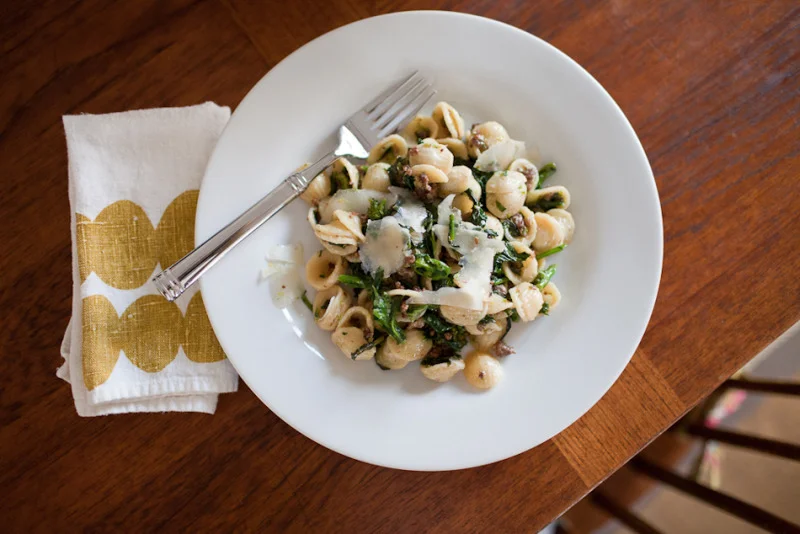
orecchiette carbonara

We have a special category for certain types of meals in our house: BHubb meals. As in, 'that's a BHubb dinner', which tranlates to 'that's the kind of dish that makes Brian, aka BHubb, a happy man'. Typically a BHubb meal is rich and heavy, and most often has some sort of pork product involved. Examples of BHubb meals from the past include Slow-Cooked Carnitas, Pappardelle with Spicy Pork Ragu, and Bacon Garlic Marinara with Homemade Meatballs. You see, sometimes I get on a salad kick, or a soup kick, and there will be weeks where most of our meals are one or the other. Those are most definitely NOT BHubb meals, because once Brian leaves the table he is rummaging for more sustenance in the pantry within half an hour. I am trying to be better about the balance between AHubb and BHubb meals in our house, and I must admit that I get a lot of satisfaction out of Brian's vigorous nod of approval after his first bite of a dinner made specially with him in mind. 

I knew going in that this Orecchiette Carbonara would get such a nod. Brian already expected something delicious when he got home last night, as I'd asked him before he left for work to slice 6 long strips of bacon from the cured pork belly we had waiting in our fridge. His eyebrows went up as he said 'bacon, huh?!?', and happily got to work carefully releasing slice after slice from the slab. And once at the dinner table, true to form, with his mouth still full Brian looked to me, pointed at the bowl in front of him, and gave me that content bob of his head letting me know that this, for sure, was a Bhubb meal.

This is a dish that I feel certain will make a frequent appearance at our table. We almost always have each of these ingredients on hand, aside from perhaps the leeks which, in a pinch, could be substituted with sweet onion.  Orecchiette can occasionally be difficult to find, but is worth the effort if you do. The tiny ear-shaped pasta is perfect for catching the peas and bits of bacon. If you have trouble, substitute shells or bowties.

Orecchiette Carbonara

serves 4

Ingredients

  • 6 slices high-quality, thick-cut bacon
  • 2 medium leeks, white + pale green parts only, halved lengthwise and cut crosswise into 1/3-inch pieces
  • 2 garlic cloves, minced
  • 1 cup frozen peas, thawed
  • 10 oz orecchiette pasta or small shells
  • 2 large, high-quality egg yolks, room temperature
  • 1/4 cup heavy cream
  • 1/2 cup freshly grated parmesan cheese
  • 1 tbsp fresh parsley

Method

  1. Cook bacon until crisp. We like to cook our bacon in the oven at 400° for about 15 minutes on a rimmed baking sheet, but cooking it in a skillet on the stove top is fine, too. Transfer the cooked bacon to a paper towel to drain, and set aside. Reserve 2 tbsp of the bacon fat, keeping it in the skillet or pouring it from the baking pan into a skillet.  Once the bacon is cool, break it into small pieces.
  2. Add the leeks and garlic to the skillet with the bacon fat, and saute' over medium heat until tender, about 6 minutes. Add the peas and stir to heat evenly. Set aside.
  3. Meanwhile, cook pasta in a large pot of boiling salted water until just tender, about 8 minutes. Drain pasta, reserving 1/2 cup of the pasta cooking water.
  4. Whisk the egg yolks, parmesan, and cream together in a medium bowl. Gradually add 1/4 cup of the pasta cooking water. 
  5. Add the pasta to the leeks and stir to mix over medium heat, just until all is heated through and the leeks are just starting to sizzle again. Remove the skillet from the heat and pour egg mixture over pasta. Stir until the sauce is just creamy and eggs are no longer raw, about 2 minutes. You can return the skillet to very low heat if the egg mixture is still runny, but be careful not to overcook. If the pasta needs to be moistened, you can add some of the reserved pasta cooking water back to the pan.
  6. Stir in the bacon and parsley, blending well.
  7. Serve with additional cheese and freshly ground black pepper.

Thursday
Sep222011

apple dapple cake, and some food photography tips

I mentioned last week that I'd be giving a little chat about food photography underneath the Relay Foods tent at the Heritage Harvest Festival last Saturday. Since so many of my readers are not local and would not have had the opportunity to stop by, I thought I'd post a summary of that presentation here on Bella Eats. And, for those of you who just want the recipe for the apple dapple cakes pictured throughout, it's at the end. :)

I get questions quite often about my photography and how I capture the images that I present here. The most important piece of advice that I ever give inquiring minds is this: PRACTICE. If you reach waaayyy back in the Bella Eats archives you'll see that my photography has changed immensely in the nearly 3 years since I've been sharing recipes from my kitchen. In fact, I give this little weblog 100% credit for renewing my passion for photography after architecture stole it away for 10 years. When I began Bella Eats I relied mostly on my little Canon Powershot point-n-shoot camera, and quickly switched over to my DSLR once the focus of the site moved from a daily food diary to a more focused recipe + photography portfolio. With that change, the amount of time I spent capturing images for each recipe increased. With each post my eye strengthened and developed until I'd created a style all my own, certainly influenced by but never outright imitating other food photographers that I admire. The reason that my photography looks and feels as it does today is because I keep picking up my camera, keep following the blogs and magazines and artists that inspire me, keep challenging myself in new ways with each project I tackle. And I promise you, 3 years from now my photography will be different than it is today because of the life I will live during that time. Everything experienced in life is an influence on one's art. So...PRACTICE. It is the ONLY way to become the photographer you wish to be. Everything else is just details.

And now, on to those details. This is by no means a comprehensive guide or the 'right/only' way to photograph food. I mostly hope to give some insight into how I work, and the decisions I make while capturing images for Bella Eats. I don't go into the technical aspects of working your camera, but simply challenge you to look at your photography from another point of view. If you have any specific questions, please feel free to ask them in the comments section!
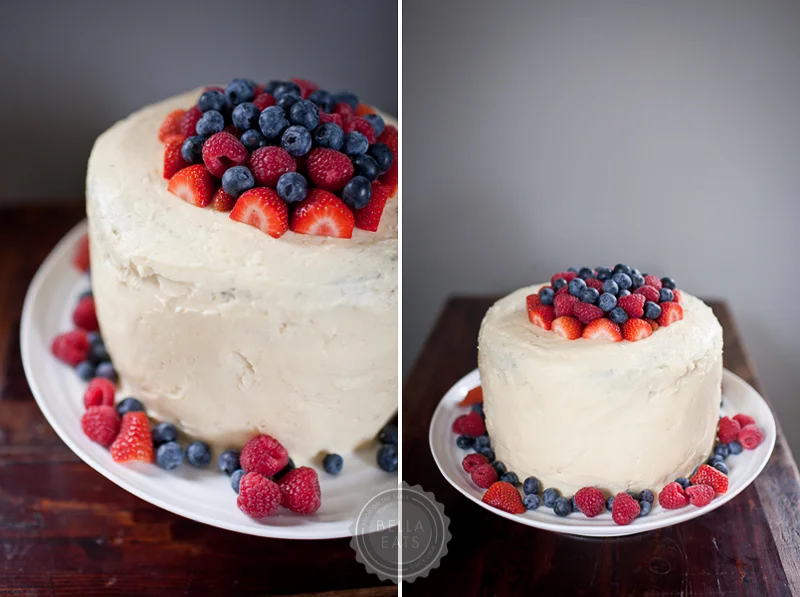
I first want to show you that I don't have a big fancy studio with a beautiful gourmet kitchen directly adjacent to it. Boy, do I wish I did! Someday... Right now Brian and I share a 10'x10' home office space, one side dedicated to our desks and computers and the other dedicated to my work table, some prop storage, and camera equipment. The end of that table is where most of my photography happens, unless I'm feeling like a different sort of lighting or need a bit more space, and then I'll move out to our dining room. (I'll show you the difference in light quality between those spaces a little later.) It is very helpful to have this dedicated space for photos, so that our dining room isn't constantly taken over with my equipment as it was for the first 2 years of writing Bella Eats. If you can manage to clear off a 2'x3' space to keep set up, I highly recommend it.

LIGHT

All recipes on Bella Eats are photographed using natural light. I did dabble with artificial lighting momentarily, and occasionally break out my Lowel Egos if I will be shooting on location in a restaurant, but 95% of the time the images captured are lit using indirect or diffused sunlight. So, the first thing that I do when I am planning to photograph a recipe is I think about the quality of light that I am looking for in my images. The pair of shots below demonstrates the difference in lighting in my dining room (left) versus my studio (right). Both images are perfectly fine, but there are subtle differences that I'd like to point out:

1. Temperature. My dining room windows face west and north, and these images were captured in the late afternoon, so the color cast in that space was much warmer than the cast in my office/studio, which faces east and north. 

2. Direction of light. In the image on the left, the windows are to the left and in front of the camera, which highlights the cake stand nicely but casts more shadow on the right side of the cut piece. In the image on the right, the windows are to the left and behind the camera, which provides nice, even lighting on the cut piece but leaves the depth of the image more flat. The difference is especially apparent if you look at the folded end of the gray towel.

Again, neither of these images represents the 'right' way to light a subject, just two different perspectives. And there are many, many more options!

CLEAN + STAGE

This is pretty self explanatory. Do as much set-up as you can before you step foot in the kitchen. Analyze the recipe, pick your backdrops, linens, dishes, and extra props. Set up the camera and stage the first shot while thinking about how you plan to capture the others. For something like these mini cakes, this step isn't as big of a deal. But if you have a cast iron pan of fajitas coming off the stovetop and you want to photograph the steam rising from those sizzling veggies, you better have your studio space ready to go!

RECIPE ANALYSIS

Just because a recipe for cake says that it should be baked in an 8-inch round cake pan, doesn't mean it has to be! Read through the recipe thoroughly and think about how you'd like to present the food. Individual cakes are fun to photograph, but a whole cake provides a slew of cutting/serving options. Will the food be photographed in the dish that it is prepared in? Or can you ignore the cooking dish because the food will be removed and plated? Do you want to capture multiple stages of the cooking process and, if yes, which of those stages should be documented and where? 
PROPS

Analyzing the recipe will give clues as to what vessels should be used to present the food. Most often you can't go wrong with a white dish, but sometimes a colorful serving piece can really help to set off the colors in a recipe, such as these strawberry tarts on the teal plates shown below.
BACKDROPS

Once I've analyzed the recipe and chosen the dishes I'll use, I pick the backdrop for the photographs. The backdrop has a huge influence on the overall feel of the images, taking it from rustic to refined with a switch from the pallet to the ebony floor sample. As you can see, Lowe's and Home Depot can be a great place to pick up photo backdrops.

TEXTURES + COLOR

Once I've chosen the dishes and the backdrop, I move on to the styling of the images. Again, colors + textures can have a huge influence on the overall feel of the scene. Below I've shown examples of those little apple cakes styled in three simple ways, from neutral to pastel to festive. This recipe was pretty much a blank slate, given its neutral tone and white ramekin. But, imagine this beet risotto in that orange scene...blech!

I have a slew of colored and patterned papers and linens that I sort through all the time. The key is to have a good variety so you never get bored. Sometimes, though, I will realize that I've really had a thing for the pallet paired with natural linen and antique silverware (who doesn't?) and have to force myself to think outside of the neutral box, which is typically my preference. Again, challenge yourself! Find a fun linen or paper and work to style your entire scene around it.

VIEWPOINT

There are three viewpoints typically used in food photography: front, angled, top. I use them all, typically in each post. If you find yourself always shooting from one direction be sure to switch things up and challenge yourself to a new point of view. 

DEPTH OF FIELD

The depth of field in an image refers to the depth of the image that is in focus, and is controlled by the camera's aperture. This is a subtle nudge to explore the settings on your camera beyond 'auto'. Again, none of these is the 'right' aperture to set your camera to, but is simply a demonstration of how the story you tell with your art can be influenced by the depth of field.

FOCAL POINT

Similar to the depth of field, the point of focus in the image can alter the story told. Below I've focused on the first, the middle, and then the last cake. In the image below that I've focused first on the forks and then on the cake. Quite literally, the focal point will draw attention to the point of the image that you wish to be the focus, and it doesn't always fall right in the middle of the frame.

CROP

Does the whole dish need to be present in the frame for you to convey its qualities?

CLUTTER

I often find that less is more. In the case of the two images below, I really wanted to show the sauce I made to accompany the cake. However, the image on the left felt a bit too cluttered, and I was much happier with the shot once I removed the little bowl.

Instead, I found two different ways to set up and style additional images with the sauce as the focus. I would probably pair one of these with the image on the right, above, in a blog post.

SHOW MORE OF THE STORY

Don't lose sight of the fact that food is meant to be eaten, and showing only the final, pristine cake is not the whole story. Slice it, dish it, eat some of it, and photograph each of those stages. Some of my favorite images show a half-eaten piece of cake or an empty plate, typically found at the end of a post.

POST-PROCESSING

It is my goal to do as little post-processing as possible, always. My love for photography falls in the styling and capturing of images, not in sitting behind my computer tweaking settings until the image looks nothing like what I caught in-camera. I adore Adobe Lightroom 3, and do most of my editing there. It is a powerful editing program and fantastic for organizing my images, of which I take a lot. For an average Bella Eats post I'll take between 60-100 images, and typically whittle them down to 10 that actually go in the post. Lightroom is great for that process. I rarely take images into Photoshop, and when I do it is usually only to remove a stain from a backdrop paper I've used one too many times, or to collage multiple images together (I am still not happy with doing this in Lightroom, for some reason). I even add my watermark as I export images at web-resolution from Lightroom.

The image on the left is straight from the camera, and on the right after a little brightening, a little warming, and a little clarity.....and that's about it.

Same for the images below, except I also removed that little paint spot from the homosote, also in Lightroom. I can be picky.

And...that's it! My process for capturing photographs of food. Again, if there are any specific questions, please ask in the comments section below! I'll go ahead and answer one right now, because I know I'll get it:

Q: What camera equipment do you use for food photography?

A: Canon 5D MkII, Canon 50mm f1.4, Canon 100mm f2.8, Canon 35mm f1.4L

On to cake. Seriously, this recipe is one of our new favorites. I seem to say that a lot, but I really, really mean it with this one. So simple, so delicious, easy to travel with (I lugged the full cake and the mini cakes to the festival for my demonstration last night, and they fared perfectly). It has a consistency similar to coffee cake - soft and spongey and laced with fruit and nuts. Meaning...it is great for breakfast. And you know I LOVE a cake that I can eat for breakfast. :)

Apple-Dapple Cake

from Mollie Cox Bryan's Mrs. Rowe's Little Book of Southern Pies (the original recipe is for pie)

makes (8) 4-inch cakes, or (2) 8-inch cakes

Ingredients

  • 3 eggs
  • 2 cups sugar
  • 1-1/2 cups light vegetable oil
  • 1 tsp vanilla extract
  • 3 cups all-purpose flour
  • 1 tsp baking soda
  • 1 tsp ground cinnamon
  • 1 tsp salt
  • 3 cups diced apples
  • 1 cup chopped raw or toasted nuts (I used sliced almonds)

Method

  1. Preheat oven to 350°F. Butter (8) 4-inch ramekins or (2) 8-inch cake pans.
  2. Beat the eggs, sugar, oil, and vanilla in a large bowl until thoroughly combined. Add the flour, baking soda, cinnamon, and salt and mix thoroughly. Stir in the apples and nuts until evenly distributed, then spoon the mixture into the prepared baking dishes.
  3. Bake for 40-50 minutes, until a toothpick inserted in the center comes out almost clean, then transfer cakes to wire racks to cool. (The small cakes took about 40 minutes, the larger the full 50 minutes.)

We enjoyed ours served with this rum caramel sauce.

Page 1 ... 4 5 6 7 8 ... 65 Next 5 Entries »